Tailor-Made Private Ephesus Tour with Local Experiences
 12889P2
 12889P2
 12889P2
 12889P2
 12889P2
 12889P2
 12889P2
 12889P2
 12889P2
 12889P2
 12889P2
 12889P2
Overview
*Experience local food and beauties of Turkey together with must-see places.
*Explore local shops before embark on your cruise.
*Skip-the-line all entrances with pre-purchased tickets. Pay for the tickets at the end of your tour.
This is a guided private tour. You will be the only one have your guide's attention and use your valuable time wisely during your stay in Kusadasi port of call. After you meet with your guide at the port, you will create your own unique itinerary. You can choose to visit any of the places below,
*Ephesus Ancient City
*Terrace Houses of Ephesus
*Virgin Mary's House
*St. John Basilica
*Temple of Artemis
*Sirince Old Greek Village
*Kusadasi Town Center
*Handcraft Shops and Ateliers
*A delicious lunch in a local village atmosphere.
Tour at a glance
What's included
- Brand New A/C Luxury Mercedes Vito with Private Driver
- Pick Up and Drop Off for the Cruise Guests
- Professional Licensed English Speaking Tour Guide
- A Delicious Local Lunch
- Guaranteed skip-the-line tickets
Not included
- Admission fees
- Alcoholic beverages
- Admission fees
- Admission fees
- Admission fees
- Visiting Siringe Village
Itinerary
-
1
The House of the Virgin Mary
House of Virgin Mary is located on the top of the "Bulbul" mountain 9 km ahead of Ephesus, the shrine of Virgin Mary enjoys a marvelous atmosphere hidden in the green. It is the place where Mary may have spent her last days. Indeed, she may have come in the area together with Saint John, who spent several years in the area to spread Christianity. Mary preferred this remote place rather than living in crowded place. The house of Virgin Mary is a typical Roman architectural example, entirely made of stones. In the 4th century AD, a church, combining her house and grave, has been built. The original two-stored house, which consisted of an anteroom (where today candles are proposed), bedroom and praying room (Christian church area) and a room with fireplace (chapel for Muslims).
45 min Admission not included -
2
Ephesus Ancient City
This enclosure for archaeological remains at Ephesus elegantly reconciles historic conservation with accessibility for visitors. The site of a succession of great ancient civilizations, Ephesus, on the south-west coast of modern Turkey, embodied a peculiarly fertile synthesis of architecture and culture. In 356BC the Greeks built the Artemesium (a colossal Ionic temple dedicated to Artemis the fertility goddess) which was one of the Seven Wonders of the ancient world. During the 2nd century BC, Ephesus was the fourth largest city in the eastern Roman Empire, famous for its Artemision Temple, the Library of Celsus and its medical school..
1h 30m Admission not included -
3
State Agora
The agora on the southern part of the Basilica is the State Agora and was built in the Roman Period in the first century B.C. This agora was used not for commerce but for business, it played an important role as a meeting place for governmental discussions. During the excavations in the northeast corner of the Agora were found a great number of graves from the 7th-6th centuries B.C and a stone-paved road, and an archaic sarcophagus of terra cotta. From this, it is understood that in the archaic period this part of the Agora was used as the necropolis of Ephesus. There is a water reservoir at the corner of the Agora, which played an important role in Ephesus. Its water was brought to the city through the Pollio Aqueduct, the remains of the Pollio Aqueduct can be seen 5 kilometers away, along the Selçuk-Aydin highway.
15 min Admission not included -
4
The Odeion
This building has the shape of a small theatre with the stage building, seating places, and the orchestra. It had a double function in use. First, it was used as a Bouleuterion for the meetings of the Boules or the Senate. The second function was the Odeum as a concert hall for the performances. It was constructed in the 2nd century A.D by the order of Publius Vedius Antonius and his wife Flavia Paiana, two wealthy citizens in Ephesus. It had a capacity of 1500 spectators. It had 3 doors opening from the stage to the podium. The podium was narrow and one meter higher than the orchestra section. The stage building was two-storeyed and embellished with columns. The podium in front of the stage building and some parts of the seating were restored. The Odeon used to be enclosed with a wooden roof. Two councils administrated Ephesus. These were Demos or the parliament which was open to the public was taken place in the great theatre and the Bouleia which gathered in this small theatre.
15 min Admission not included -
5
Temple of Hadrian
Temple of Hadrian is one of the best-preserved and most beautiful structures on Curetes Street. It was built before 138 A.D by P. Quintilius and was dedicated to Emperor Hadrian, who came to visit the city from Athens in 128 A.D The facade of the temple has four Corinthian columns supporting a curved arch, in the middle of which contains a relief of Tyche, goddess of victory. The side columns are square. The pedestal with inscriptions in front of the temple is the bases for the statues of the emperors between 293-305 CE, Diocletian, Maximian, Constantius I, and Galerius; the originals of the statues have not been found yet.
10 min Admission not included -
6
Temple of Domitian
Located at the south end of Domitian Street, it is the first structure in Ephesus known to be dedicated to an emperor. It was built on a high and wide terrace set by 50x100 meters in size, on vaulted foundations. The northern side of the terrace seems to be two-stories high, reached by stairs. The stairs are still visible today. The temple, built in the pro-style plan, had eight columns on the short side and thirteen columns on the long side, and four additional columns in front of the cella. On the northern side, there was an u-shaped altar, which is now displayed in the Izmir Museum. It was in the reign of Domitian that an emperor gave permission to build an Emperor Temple; that is the permission to be the 'neocoros' for the first time, which was a great honor for a city. It was in the reign of Domitian that an emperor gave permission to build an Emperor Temple; that is the permission to be the 'neocoros' for the first time, which was a great honor for a city.
15 min Admission not included -
7
Hercules Gate
Hercules Gate is located towards the end of Curetes Street, it was called the Hercules gate because of the relief of Hercules on it. It was brought from another place in the fourth century AD to its current place, but the relief on it dates back to the second century AD. Only the two sides of the columns remain today and the other parts of it have not been found. The relief of the flying Nike in the Domitian Square is thought to also be a part of this gate. The Heracles Gate narrowed the access to the street, preventing the passage of vehicles. We can understand that from the Fourth Century, the street had become a pedestrian area.
Pass by (no stop) Admission free -
8
Ephesus Terrace Houses
Ephesus terrace houses are located on the hill, opposite the Hadrian Temple. Also called "the houses of wealthy Romans", important for the reason give us information about family life during the Roman period. They were built according to the Hippodamian plan of the city in which roads transected each other at the right angles. There are six residential units on three terraces at the lower end of the slope of the Bulbul Mountain. The oldest building dates back to 1C BC and continued in use as a residence until 7C AD. Ephesus terrace houses are covered with protective roofing which resembles Roman houses. The mosaics on the floor and the frescos have been consolidated and two houses have been opened to the public as a museum.
30 min Admission not included -
9
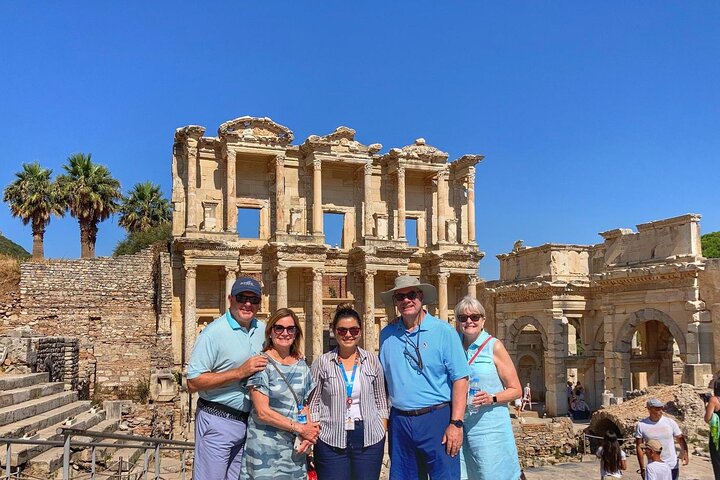
Celsus Library is one of the most beautiful structures in Ephesus. Celcius Library was built in 117 A.D. Celsus Library was a monumental tomb for Gaius Julius Celsus Polemaeanus, the governor of the province of Asia; from his son Galius Julius Aquila. The grave of Celsus was beneath the ground floor, across the entrance and there was a statue of Athena over it. Because Athena was the goddess of wisdom. The scrolls of the manuscripts were kept in cupboards in niches on the walls. There were double walls behind the bookcases to prevent them from the extremes of temperature and humidity. The capacity of the library was more than 12,000 scrolls. It was the third richest library in ancient times after the Alexandra and Pergamum.
15 min Admission not included -
10
Ephesus theatre is the most magnificent structure in the Ephesus ancient city. The Ephesus Great Theatre is located on the slope of Panayir Hill, opposite Harbor Street, and is easily seen when entering from the south entrance to Ephesus. It was first constructed in the Hellenistic Period, in the third century BC during the reign of Lysimachos, but then during the Roman Period, it was enlarged and formed its current style that is seen today. t is the largest in Anatolia and has a capacity of 25,000 seats. The cavea has sixty-six rows of seats, divided by two diazoma (walkway between seats) into three horizontal sections. There are three sections of seats. In the lower section, Marble pieces, used for restoration, and the Emperor's Box were found. The Ephesus theatre was used not only for concerts and plays but also for religious, political, and philosophical discussions and for gladiator and animal fights.
15 min Admission not included -
11
Basilica of St. John
It is believed that the evangelist St. John had spent his last years in the region around Ephesus and was buried on the southern slope of Ayosolug Hill. Three hundred years after the death of St. John, a small chapel was constructed over the grave in the 4th century. The church of St John was changed into a marvelous basilica during the region of Emperor Justinian (527 -565 AD). The second half of the first century was full of persecution for the early Christians. Apostle James and Stephen were killed in Jerusalem. Paul was sent to Rome and executed. According to tradition John took The Mother Mary and came to Ephesus. He wrote his Gospel in Ephesus and the Revelation on Greece Island, Patmos in 96AD.
30 min Admission not included -
12
The Temple of Artemis
The Temple of Artemis is known as one of the Seven Wonders of the ancient world. It has been built in the areas of Ephesus on a flat area which has over the centuries turned into a swamp. If you visit Ephesus today, you can only see the ruins of the foundations of this marvelous construction of the Hellenistic Age, entirely made of marble and full of sculptured columns' capitals and shafts. The most beautiful remaining of this temple are today exhibited in the London British Museum.
25 min Admission free -
13
Okuz Mehmet Pasa KervansarayI
The caravanserai was commissioned by Öküz Mehmed Pasha, who served as Governor of Ottoman Egypt and Grand Vizier. It was constructed between 1615 and 1618. Constructed in the form of a fortress to meet the needs of the time, the caravanserai was used as customshouse. The Directorate of Foundations started the renovation of the almost-ruined caravanserai in 1954 that continued until 1966.The cost of renovation totaled to ₺2.1 million (approx. US$0.21 million), not including the cost for nationalization of shanties on three sides of the ruined structure.
10 min Admission free -
14
Kusadasi Bazaar
At the end of your tour, you can have free time in a local market area of Kusadasi town. It is a huge market with all kinds of shops. from Turkish goods, to leather products, to sweets, to knick-knack to a bunch of fake clothes and watches, it has lots of stuff.
1h Admission free
Meeting & pickup
Hotel pickup is included for all travellers.
FOR CRUISE PASSENGERS; WE MEET GUESTS AT THE EXIT GATE OF THE IMMIGRATION TERMINAL OF THE KUSADASI CRUISE PORT WITH A BOARD WITH OTTI TRAVEL SIGN ON IT. FOR PICK UP FROM KUSADASI HOTELS, WE MEET GUEST BY THE HOTEL RECEPTION. FOR IZMIR AIRPORT (ADB) PICK UP, WE MEET GUEST AT THE EXIT GATE OF THE DOMESTIC TERMINAL WITH A BOARD WITH OTTI TRAVEL SIGN ON IT.
Schedule
Good to know
- Wheelchair accessible
- Infants and small children can ride in a pram or stroller
- Specialized infant seats are available
- Transportation options are wheelchair accessible
- Not recommended for travelers with poor cardiovascular health
- Travelers should have at least a moderate level of physical fitness
- At time of booking, Cruise ship passengers must provide the following information at time of booking: ship name, docking time, disembarkation time and re-boarding time
Cancellation policy
For a full refund, cancel at least 24 hours before the scheduled departure time.
Traveller reviews
Wonderful tour! Learned a lot and greatly enjoyed the tour especially with our guide, Tesli. Good lunch and interesting info!
Phenomenal experience! What an immersive sense you have walking among theses ancient ruins that give you a true sense of the entire community . Our local guide Alsi was delightful and so kind and knowledgeable of the history.
Our family took this tour and had Zeynep as our guide. She is very knowledgeable and personable. We had a great day learning and seeing a lot of the sights. If your visiting Turkey from the cruise ship port in Kudasi I would recommend this tour!
Our Tour guide Malike was amazing. She made sure we are comfortable at each step even in extreme heat. She took us to amazing places for food, For leather jackets, carpets. Ephesus tour was also excellent so much history and she explained everything so nicely and in detail. If I have to ever do it again I will choose her as my guide.
The greatest experience and more than we ever dreamed. Merivel was the best! We were overwhelmed by Ephesus and the ruins. So amazing! We enjoyed a wonderful Turkish meal and bought a TURKISH RUG! I can’t say enough about how great she was. She was so knowledgeable about everything and gave us so many unforgettable experiences. We enjoyed the market and Turkish coffee experience. This was the best tour experience ever!
I went on a tour in Ephesus with Celine and it was amazing! She was incredibly knowledgeable, super engaging, and truly made the history of Ephesus come alive. What really blew me away was how personalized the experience felt—she knew all the absolute best photo spots, knew the rich history inside and out, and perfectly tailored the timing to go at my pace without ever feeling rushed. If you’re visiting Ephesus, do yourself a favor and book with Celine. I honestly couldn’t recommend her highly enough!
Ahmed our tour guy was wonderful. He was very knowledgeable but also was very personable and easy to talk to. He made sure that we saw everything we wanted to see and was very accommodating. Definitely one of the best tour guides we have had.
Did this as an excursion from a cruise ship - and can't recommend it enough! Was so nice to have our own guide, and not get herded like cattle into busses and through everything. Our guide, Asli, personalized the experience to the highlights we wanted to see, and made excellent recommendations. She was very mindful of getting us back in plenty of time to get back on the boat. Lunch was amazing - and even the rug demonstration was wonderful and not crazy pushy. Very respectful. Highly recommend.
Reviews are collected by Viator and Tripadvisor from verified travellers.
Product code 12889P2
More in Kusadasi
 5.0 (11,850)
Private tour
62334P2
5.0 (11,850)
Private tour
62334P2
 5.0 (9,024)
Private tour
18736P19
5.0 (9,024)
Private tour
18736P19
 5.0 (1,367)
Private tour
18736P1
5.0 (1,367)
Private tour
18736P1
 5.0 (617)
Boat tour
62334P14
5.0 (617)
Boat tour
62334P14
 4.9 (585)
Private tour
12889P1
4.9 (585)
Private tour
12889P1
 5.0 (185)
Private tour
193373P1
5.0 (185)
Private tour
193373P1